The Levin Lab
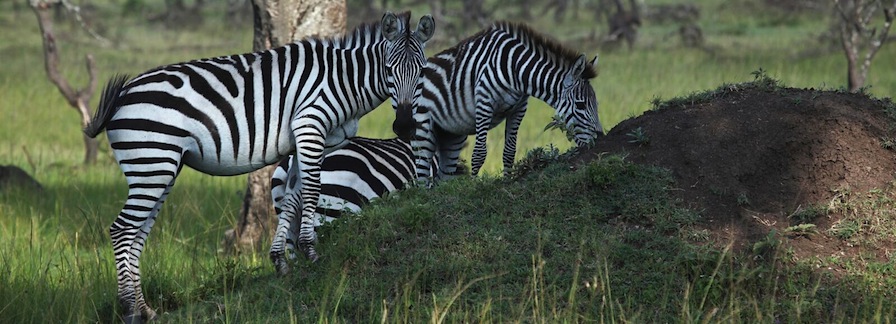
| Photo: In drylands, termite mounds are valuable resources for zebras and other animals. See: Bonachela, J.A. et al. 2015. Termite mounds can increase the robustness of dryland ecosystems to climate change. Science 347(6222): 651-655. Photo by Robert Pringle, Princeton University, Department of Ecology and Evolutionary Biology. | ||||||||||||||||||||||||||
| Levin Lab - 2015 Publications | ||||||||||||||||||||||||||
|
||||||||||||||||||||||||||
| 2015 Berdahl, A. et al. (including S. A. Levin). 2015. On the evolutionary interplay between dispersal and local adaptation in heterogeneous environments. Evolution 69(6): 1390-1405. .pdf Bonachela, J.A. et al. (including S.A. Levin). 2015. Termite mounds can increase the robustness of dryland ecosystems to climate change. Science 347(6222): 651-655. .pdf Carter, N. et al. (including S. A. Levin). 2015. Modeling tiger population and territory dynamics using an agent-based approach. Ecological Modelling 312: 347-362. .pdf Castillo-Chavez, C. et al. (including S.A. Levin). 2015. Beyond Ebola: Lessons for mitigating pandemics. The Lancet 3 (July 2015): e-354-355. .pdf Chisholm, R. A. et al. (including S.A. Levin). 2015. The potential for alternative stable states in nutrient-enriched invaded grasslands. Theoretical Ecology: DOI: 10.1007-s12080-015-0258-8. .pdf Farrior C. et al. (including S.A. Levin). 2015. Decreased water limitation under elevated CO2 amplifies potential for forest carbon sinks. PNAS 112(23): 7213-7218. .pdf Hannam, P.M. et al. (including S.A. Levin). 2015. Incomplete cooperation and co-benefits: Deepening climate cooperation with a proliferation of small agreements. Social Science Resource Network (January 1, 2015). Climatic Change: DOI: 10.1007/s10584-015-1511-2. .pdf Levin, S.A. Foreword: A personal perspective on landscape ecology in the United States. 2015. History of Landscape Ecology in the United States, ed. Barrett G.W. and T.L. Barrett, v-viii. New York: Springer. Levin, S.A. 2015. Foreword: What mathematics can do for sustainability. Bulletin of Mathematical Biology: Special Issue on Sustainability 77: 251-253. .pdf Levin, S.A. and I.D. Couzin, eds. 2015. Journal of Statistical Physics: Special Issue: Collective Behavior 158(3). Preface by Levin and Couzin. Levin, S.A. and A.W. Lo. 2015. Opinion: A new approach to financial regulation. PNAS 112(41): 12543-12544. .pdf Messier, C. et al. (including S.A. Levin). 2015. From management to stewardship: Viewing forests as complex adaptive systems in an uncertain world. Conservation Letters: DOI: 10.1111/conl.12156. .pdf Morin, B. et al. (including S.A. Levin). 2015. The social value of private infectious disease-risk mitigation in a rich/poor world. Theoretical Ecology: DOI: 10.1007/s12080-015-0262-z. .pdf Schertzer, E., Staver, A.C., and S.A. Levin. 2015. Implications of the spatial dynamics of fire spread for the bistability of savanna and forest. Journal of Mathematical Biology 70: 329-341. .pdf Tarnita, C. et al. (including S.A. Levin). 2015. Fitness tradeoffs between spores and nonaggregating cells can explain the coexistence of diverse genotypes in cellular slime molds. PNAS 112(9): 2776-2781. .pdf Van Boeckel, T.P. et al. (including S.A. Levin). 2015. Global trends in microbial use in food animals. PNAS 112 (8): 5649-5654. .pdf Villa Martin, P. et al. (including S.A. Levin). 2015. Eluding catastrophic shifts. PNAS 112(14): E1828-E1836. .pdf |